Want to head into our Lunatic concert knowing your stuff? Check out our program notes by the awesome young musicologist Kathryn Bacasmot!
- - - -
The most terrifying things are those that appear familiar on the outside, but are alien within. For centuries societies blamed strange events or intermittent loss of sanity on the phases of the moon (luna). Lunatics, they called these victims. What was particularly disturbing about the idea of lunatics was their instability, or rather, their changeability. Trapped behind a familiar face was something all together alien that bent and disarmed the mind uncomfortably. On the program today are a series of pieces that that employ standard musical forms that are permutated through a lunatic lens. Like a fun house of mirrors, what you see is not always what you will get. Perception is not reality, or vice versa.
Did you know Battle Music was a legitimate genre? From the 16th century all the way into the 18th it was the rage. During the Baroque in particular, the music was not meant to describe specific battles or events, but was used more for “dramatic or allegorical purposes.” Charles Burney (1726-1814), the intrepid music historian, said of Heinrich Ignaz Franz von Biber (1644-1704): “of all the violin players of the last century Biber seems to have been the best, and his solos are the most difficult and most fanciful of any music I have seen of the same period.” Fanciful elements included his use of scordatura (mistuning), and compositions that included replications of the sounds of birdcalls and bells.
Biber’s Battalia à 10 was written in 1673. Keep that in mind, especially when you hear the second movement, Die liederliche Gesellschaft von allerley Humor (“The dissolute society of all sorts”), where each instrument is playing a different tune in different keys and time signatures to portray drunken soldiers. And you thought Charles Ives (1874-1954) was original. Biber also applied Claudio Monteverdi’s (1567-1643) Stile Concitato (“agitated style”), in which notes were rapidly repeated or trilled to evoke agitation. Watch for other effects throughout, such as the snapping of strings to imitate gunfire.
-----
This “Lunatic” program could be subtitled “Haunted by the Ghost of Arcangelo Corelli.” He was a Baroque era composer of “unparalleled influence,” over which it seems no one had a drop of anxiety. He appears a couple of times on this program, and in the Concerto Grosso No. 3 in C major of Francesco Saverio Geminiani (1687-1762), he is directly involved. Geminiani, not only a composer, but a renowned violinist, based this work on Corelli’s Violin Sonata Op. 5, No. 3. “Il Furibondo” (“the madman”) was Geminiani’s nickname bestowed upon him because of the expressivity of his compositional rhythms. Expressiveness equates madness? Now, I know you probably don’t equate the Baroque with emotional abandon, but back in the day, the Baroque was intense. It was the era that blossomed from the seconda pratica (“second practice”), the era of free dissonances, of music being liberated from primarily serving the text in a supporting role to taking center stage for the portrayal and evoking of abstract emotions.
As the Concerto Grosso No. 3 is based directly from Corelli’s Op. 5, No. 3, it is structured as a sonata di chiesa (“church sonata,” as opposed to a sonata da camera, or “chamber sonata”). Thus, it is constructed of four movements, alternating in tempo as slow-fast-slow-fast. The rhythmic and melodically dissonant rubs in this piece are delicious, like drops of honey on your fingers, sticky but sweet. If this constitutes madness, let’s all hope for a full moon.
-----
Christopher Hossfeld is going to tell you about his piece, concerto GROSSO, himself:
“concerto GROSSO can be seen in two ways: it is either a chamber piece for 18 strings, or a concerto for an 18 string orchestra where all players are soloists. In either case, it is 18 minutes long. Attempting to blur the line between chamber and orchestral music at this scale creates a grossness in the music: multiple overlapping layers, thick dissonant chords, a sense of rhythmic disorder and chaos, not to mention the physical challenge of holding the piece together. To balance this complexity the overall structure is simple: 3 movements with familiar forms: solo vs. tutti, fugue, and passacaglia/theme & variations. In one sense the forms are sterile and mathematical, while the music remains terribly personal as well.
All but Death—
The titles of the movements are literary (to a degree). Their sources will remain hidden for now (though a simple google search will reveal much), but their preoccupation is clear: death. These notes will not dwell on the personal motivations and emotions behind them: too detailed a revelation would hinder, not help, the appreciation of the music. concerto GROSSO is dedicated to the memory of a beloved aunt. The audience is invited to contemplate the movements as they are tonight, and perform further investigation if they wish.
The first movement is built on alterations between large tutti and small solo groups. The line between solo and tutti is intentionally vague. The urgent 16th notes of the theme are framed by full orchestral chords at the beginning, middle and end of the movement. As the final sounds fade, a familiar strain may be heard floating from the violas.
...AND ZOMBIES
An 18-voice triple fugue is quite disgusting to behold. Is it as disgusting as the undead, or the obsession with death?
l’enterrement d’une feuille morte
This passacaglia is part Chaconne in d minor, part Dido and Aeneas, and a lot of historical fantasy. The mood is both grave and playful. There are twelve sections in the piece (11 bass-line repetitions plus coda), each section is 12 bars long, and the whole movement is approximately 12 minutes.”
-----
Alfred Schnittke (1934-1998) suffered from a case of classic USSR creative claustrophobia. The soil beneath his feet was his homeland, familiar, and yet those who ruled upon it made it him a stranger in his own land. It has been noted Schnittke’s music inherits the Shostakovich tradition of “alienation expressed through irony.” Schnittke touted a musical style he coined Polystylism, which wove together musical traditions of the past through the lens of a modern eye using quotation, allusion, and adaptation.
The Concerto Grosso No. 1 is adapted from the Baroque concerto grosso (“big concert”), a form in which a small group of soloists (concertino) is pitted against the larger ensemble (ripieno). Arcangelo Corelli was a cornerstone composer of these works. He also codified the genre. Taking a look at the stage you might be fooled into thinking you are, in fact, at a Baroque concert, harpsichord and all. However, the familiar quickly becomes the lunatic stranger once the prepared piano emits its ghostly tintinnabular sounds – yet we know not for whom the bell tolls. We discover the genre has been delightfully, yet disturbingly, corrupted. Listen for sudden insertions of Baroque idioms, slitheringly abrasive rapid violin lines that hint at George Crumb’s Black Angels, “Corelli Clash” dissonances between the two violin soloists that seem to have suffered from lead poisoning, and a disarming visit from Tango master Astor Piazzolla (or someone like him). Oh, and be prepared to take a moment to process what you just heard before you applaud. Like a Kafka novel, this music is a self-contained world from which you might need to reacclimatize.
- - - -
Kathryn J Allwine Bacasmot
is a pianist/harpsichordist/musicologist and freelance writer. She received her Masters in Musicology at the New England Conservatory of Music with her thesis on Björk Guðmundsdóttir and aspects of the female experience in her fifth studio album, Medúlla. Check out her blog at http://piecesofmoments.wordpress.com/



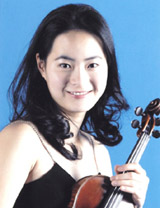 Guest Crier Hye-Jin Kim was recently announced a winner of the