

violinist
Cryin' All Summer Long
Cryin' All Summer Long!
2012 marks AFC's first summer on the road! We'll be performing at some of America's most exciting music festivals from June through August. Check out the schedule to see if we're coming your way!
Rockport Chamber Music Festival
SOLD OUT! A Far Cry in Rockport - with Andrés Cárdenes, violin, and David Deveau, piano June 14 2012 8pm Shalin Liu Performance Center - Rockport, MA
Osvaldo Golijov: Tenebrae Piazzola: Invierno and Otoño from The Four Seasons in Buenos Aires Vivaldi: Concerto for Violin, Op. 4, No. 11 in D Major from La Stravaganza Mozart: Piano Concerto No. 14 in E-flat, K. 449 Britten: Variations on a Theme by Frank Bridge
Ravinia Festival
A Far Cry in Chicagoland - with Jake Shimabukuro, ukulele July 1 2012 7pm Ravinia Park
Lully: Suite from “Le Bourgeois Gentilhomme” Special Collaboration with Jake Shimabukuro, ukulele Tchaikovsky: Serenade for Strings in C major, Op. 48 Parapaskero: Turceasca
River to River Festival
A Far Cry in New York City - with Oneohtrix Point Never & David Lang July 14 2012 7pm World Financial Center Winter Garden
David Lang: Darker Daniel Lopatin: Selections from his albums, Returnal and Replica
Music in the Meadow at the Trapp Family Lodge
A Far Cry in Vermont - featuring Kip Jones, violin/fiddle and Karl Doty, bass July 15 2012 7pm Trapp Family Lodge
(Contact the lodge directly for a special concert rate of $245 for an overnight stay after the concert!)
Lully: Suite from "Le Bourgeois Gentilhomme" Kip Jones: Double Concerto for Violin and Bass, "Three Views of a Mountain" Piazzolla: Two Tangos Beethoven: Quartet in F minor, op. 95 Perapaskero: Turceasca
Chautauqua Institution
A Far Cry in New York August 20 2012 4pm Elizabeth S Lenna Hall
Osvaldo Golijov: Last Round Mozart: Eine Kleine Nachtmusik Britten: Variations on a Theme by Frank Bridge
Kneisel Hall Chamber Music Festival
A Far Cry in Maine August 24 2012 7:30pm August 26 2012 4pm
Pärt: Fratres
Osvaldo Golijov: Last Round
Mozart: Eine Kleine Nachtmusik
Britten: Variations on a Theme by Frank Bridge

Auction Items
Our Spring Soiree is coming up: Wednesday May 2 at 6pm, The St. Botolph Club at 199 Commonwealth Avenue, Boston. This evening is always a highlight of our year, with a private concert, drinks, hors d'oeurves, and a wide-ranging auction! Tempted? Get your tickets today! Announcing our 2012 Soiree auction items:
Music by Markus Enjoy the beautiful sounds of Austrian pianist Markus Schirmer. This package includes three CDs, plus a certificate for one forthcoming CD of Markus playing Mozart’s Piano Concerto in C Major with A Far Cry, recorded this past spring in Jordan Hall. Value: $60. Opening Bid: $25.
Bow Re-hairing Help the Criers get their bows re-haired! Each re-hairing costs approximately $70. This item is a multiple-person bidding item (meaning, each person pays for as many re-hairings as you wish). Value: $70 each. Opening bid: $70.
Isabella Stewart Gardner Friend Membership Become a member of the museum where A Far Cry is the Chamber Music Orchestra in Residence. This membership includes: unlimited free admission for two adults for one year (children are admitted for free), invitations to members-only exhibition previews and special events, special member prices and advance notice for concerts and lectures, invitation to New Member Tour, 10% discount at the museum store, Gift of the Gardner, in the new building. Value: $95. Opening Bid: $50.
Learn to Tweet Baffled by the world of tweeting? Need help navigating Facebook or other forms of electronic media? Crier Miki Sophia Cloud will step you through this world of social media. Learn what this means: nightafternight Me on @TheKnightsNYC + @oestreichj on @afarcrymusic + @kozinn on @neilrolnick = hippest @nytimesmusic round-up ever: http://nyti.ms/gXeTAM -- Steve Smith, The New York Times. Value: $100. Opening Bid: $50.
Choral Splendor One of Boston’s premiere choral groups, the Back Bay Chorale, is offering two tickets to one concert next season at Sanders Theater. Visit www.backbaychorale.org for concert schedule. Value: $100. Opening bid: $50.
Voice Lesson with Kristen Watson Highly acclaimed soprano Kristen Watson (who will be performing with A Far Cry next season!) offers one seventy-five-minute voice lesson for male or female voice. (Beginner level welcome.) Value: $110. Opening bid: $70.
Spend Christmas with Bach Join renowned Emmanuel Music for Bach’s Christmas Oratorio on Saturday, December 1, 2012, 7:30PM. Two first-tiered seats. Value: $150. Opening bid: 75.
Pie-A-Month Club Who has time to bake? Award-winning pie baker Margaret Darling, mother of award-winning violist/Crier Sarah Darling, will bake a total of six pies for you throughout the year, and a Crier will deliver them to your home. (Times to be determined). Value: $200. Opening bid: $100.
Spring (or Fall) Garden Clean-Up Experienced gardener Kelly Reed offers one day (4-5 hours) of spring or fall garden clean up. Offer includes: raking out beds, hoeing, trimming back plants, preparing for plantings. Kelly will supply all tools. Value: $250. Opening bid: $125.
Paddle Vermont Experienced canoe guide Jean Gerber will take you and a guest down one of Vermont’s scenic rivers. Spend the day paddling and eating a lovely picnic lunch along the banks of a river. Then spend the night at the historic and beautiful Norwich Inn in Norwich, VT. Visit www.norwichinn.com. (Mutually agreed upon time – May through October; canoe included). Value: $400. Opening bid: $200.
Vermont Winter Retreat for Two January 20 and 21, 2013. Join the Criers next January for a concert in Grafton, VT. Package includes concert tickets, one night’s stay in the quaint Grafton Inn and a one-day pass to Grafton Ponds Cross-country Ski Center. Visit www.graftonponds.com and www.graftoninnvermont.com. Value: $400. Opening bid: $200.
Can we Talk? Criers are in desperate need of a better way to communicate with each other while on the road. Please help us purchase a conference call machine that will allow everyone to call and video-chat into the office for meetings. Value: $400. Opening bid: $200.
Wow, Do We Need a Scanner! Please help us purchase a new scanner so we can more easily scan our music saving us hours of time. Value: $400. Opening bid: $200.
Block Island Summer—A Romantic Getaway for Two Stay in a beautiful condo, owned by David and Felice Silverman, on Block Island and enjoy this lovely island’s beaches and restaurants. Dates that condo is available: July 30 through August 10, 2012. Value for one week: $1300. Opening bid: $500.
Your Own Crier String Quartet You choose the time (up to two hours) and place (around the Boston area), and A Far Cry will provide a world-class string quartet plus a pre-concert lecture. This is a wonderful way to promote the Criers. Let your imagination run wild: what would YOU do with your own string quartet? Value: $1,400. Opening bid: $800.
Crying in Vienna Join the Criers for their European Debut. A Far Cry will play with powerhouse Austrian pianist Markus Schirmer on October 20, 2012 at one of the best halls in the world – Vienna’s Musikverein. Package includes: 2 tickets to the Musikverein concert, discount hotel package, dinner after the show with the Criers and your very own personal walking tour of Vienna with Crier Miki Sophia Cloud. Value: $1,800. Opening bid: $1,000.
Ecstatic Party Bus Sponsor a bus to the Big Apple on July 14, 2012 where Criers will be performing in the Ecstatic Music Festival in Central Park. Along with bus sponsorship, we invite you and a guest to ride the bus with the Criers, to join us for the concert, and to party with the gang after the concert. Value: $2,500. Opening bid: $1,000.
An Evening of Music and Food A group of Criers will come to your home (within reasonable driving distance of Boston) to play music and…yes…cook you dinner. Invite your friends and enjoy an informal evening of good music and good company. This is a wonderful way for you to introduce your friends to the Criers. Value: $3,000. Opening bid: $1,500.
Diary of an Intern - Episode #1
AFC is thrilled to announce the launch of our new internship program in partnership with New England Conservatory. Undergrad and grad students were invited to apply to be a crier this semester - doing everything from performing with the group to learning the ropes of how to run a non-profit musical organization. As part of the program, we've asked the interns to relay their insights about the experience. We hope you enjoy this first installment from Shaheen Lavie-Rouse!

Managing The Inevitable Surprise By Shaheen Lavie-Rouse, Cellist and A Far Cry Intern
I was in for a surprise. I knew it was coming. I had prepared, more than ever. But in some scenarios, no matter how much you’ve anticipated a surprise, no matter how much you try to cushion it, learn about it, or get ready for it, you’re still facing a big unknown. Playing in an orchestra, with no conductor, was the scenario I was facing last Friday morning. I was heading to A Far Cry’s first rehearsal, preparing for this weekend’s concerts at St. Johns Church and at Calderwood Hall in the Isabella Stewart Gardner Museum.
When I learned that I’m going to join A Far Cry for a concert, my first preparation was to see the group perform. As they were playing John Adams’ Shaker Loops, the last piece of the night, I was still busy keeping mental track of how they stuck together. How are they sharing a pulse, a beat, with no conductor to show it? Towards the final climax of the piece, I sensed the glue loosening. The beat was just slightly rushing. It was a subtle effect, like a negligible tectonic plate shift, only acknowledged by a neglected ticker in some U.S Geological Survey office. What I thought to be the first gaffe of the concert, a slight loss of control, slowly revealed itself as A Far Cry’s shining moment that night. The beat’s acceleration slowly revealed itself to be completely intentional. No one was losing control. It was an accelerando - a performance instruction written by the composer himself. The players were playing in unison: the 19 musicians were playing the exact same notes, exactly together, and accelerating at exactly the same, constant, steady pace. The group paced this acceleration together for over two minutes, into one final hoorah. A Far Cry’s sync reminded me of a New Yorker article I read about the Sympathetic Nervous System a couple years back. Some scientists speculate that a cryptic and yet-to-be understood facet of this system connects our brains to the brains of others neurologically. I was eagerly looking for a “Far Cry method” to keep the beat. Instead, I found out I’m in for a bigger challenge: tapping into some sort of subconscious, instinctive, brain-pulse as the beat evolves through a piece of music. No matter which practice methods I’d use to prepared for that, I knew to expect a surprise last Friday.
The thing about the unknown is, it doesn’t always turn out bad. As I finally played with A Far Cry, I remembered another part of the New Yorker article. The sympathetic nervous system isn’t something you consciously tap into. It’s just there, in the back of your mind, and there’s nothing you can do about it. The New Yorker mentioned this speculated brain network is in action when you imitate others’ yawns, or cringe if another human is in pain. Tapping into A Far Cry’s psychic beat was just as effortless and instinctive. As I breathed into my sound and started the opening notes of Schoenberg, I was relieved. This surprise couldn’t be better.
ECHOES - This Saturday in JP (Gardner already sold out!)
 What a whirlwind the past few months have been over here at A Far Cry. Since January, we've opened the new wing of the Gardner Museum with Yo-Yo Ma, collaborated with head-banging rock bands at the Ecstatic Music Festival in New York City, performed a completely fresh program at Jordan Hall, enjoyed a residency in Rockport, gone on tour to Houston, Louisiana, and Memphis, and finally, recorded our upcoming Mozart Concertos album with wunderbar Austrian pianist, Markus Schirmer. Phew!
However, as we all learned in "The Wizard of Oz," once the tornado finally sets us down on terra firma, there really is no place like home. We could not be more thrilled to be back in Boston, and are celebrating by presenting a fabulous program inspired by the echoes we hear across generations of musicians, specifically, in the city of Vienna.
Johann Heinrich Schmelzer's epigrammatic "Fechtschule" or "Fencing School" (a ballet complete with a gentleman's duel) does battle with the next-generation, Mozart's gracious Piano Concerto no. 13 in C Major. Alban Berg's virtuosic and secretive "Lyric Suite" embodies 20th century angst and passion, while Arnold Schoenberg's "Suite for String Orchestra" reaches back to monuments of the musical past and re-imagines them under new terms. We are also absolutely thrilled to be featuring the fantastic Markus Schirmer as soloist on the Mozart Concerto. We want to give you, our home audience, a sneak peak of the collaboration we will be presenting across the pond this fall when we make our European Debut. For a listeners guide to this entire program by our fabulous musicologist in residence, Kathryn Bacasmot, simply click HERE.
**Important Note!** Though we will also be presenting this program on April 1st at the Gardner Museum, that concert is already SOLD OUT. Never fear! We will be playing the same intriguing program at our wonderfully intimate and cozy "home turf" at St. John's Church in Jamaica Plain on March 31st.
With love and music, The Criers
A Far Cry in Jamaica Plain March 31 2012, 4pm St. John's Episcopal Church, Jamaica Plain, MA BUY TICKETS
Schmelzer: Balletto a 4 "Fechtschule" in G Berg: Three Pieces from 'Lyric Suite' Mozart: Piano Concerto #13 in C featuring Markus Schirmer, piano Schoenberg: Suite for String Orchestra ________________________________________________________________________
Recent Press The Boston Globe on our recent collaboration with Yo-Yo Ma: "Chamber music of the highest caliber." The New York Times: "The orchestra brims with personality or, better yet, personalities... a sensational jam." The Boston Phoenix: "This orchestra could kick your band's ass."
Be Still Your Beating Heart
 We hope you spent last night whisked away in the arms of an admirer and thinking of nothing else. However, in case you woke in the middle of the night, shuddering: "How can I sleep when I don't know what A Far Cry is up to?" never fear, darling. This one's for you.
JORDAN HALL SHOW! "HEARTBEATS" Yes, our next show will be in Jordan Hall, and will feature the power of the human heart - seat of empathy, fervent devotion, sentimental swooning, and strongest muscle in our body. Check out an emotionally rich program featuring John Adams' modern classic "Shaker Loops," Shostakovich's Quartet No. 8 (arranged for string orchestra), and a concerto for fiddle and bass by Kip Jones, featuring Kip and Crier bassist Karl Doty.
Here are the program notes by our fabulous resident musicoloist, Kathryn Bacasmot and composer Kip Jones:
Dmitri Shostakovich (1906-1975) :: Chamber Symphony, op. 110a Dmitri Shostakovich’s work gained unfettered interpretational freedom through the sequestering of its truthful origin. Secrets and whispers lie at the heart of his music. He kept no diary, save what he revealed in his scores. Suffering habitual manipulation at the hands of the government, he did what he needed to do in order to survive. Fear drove him to protect himself and his family and friends from bans on performances of his music, and public verbal lashings (such as the one he sustained during the Stalinist regime against his opera Lady Macbeth of the Mtsensk District). In some ways it could appear he was numb to his reality, agreeing to join the Communist Party, allowing himself to be paraded around on a visit to the United States as the prize of government sanctioned artists—the compliant jewel in the Party’s crown. But what would you do if the alternative option meant divorcing yourself from the country you love—your homeland? His non-verbal outlet was “...inner liberation, by means of the power of creative thought,” as David Fanning observed. The inner life of Shostakovich is so shrouded in mystery that even the book, Testimony by Solomon Vokov, that claims to be his memoirs has been questioned as to authenticity. Thus, the truth of his music lies far beyond our reach, because as Michael Mishra has wisely cautioned, “any answers, as obvious as some of them may appear to be, remain speculative.” Not surprisingly then, opinions regarding the String Quartet no. 8 run rampant, stretching across the board from extremely sentimental to blandly pragmatic. According to them he was either writing his own eulogy with suicide as the ultimate conclusion (a widely disclaimed theory, yet it has been suggested), simply throwing together a pastiche of past works that meant something to him at some time or another, or sending a concealed message regarding his true feelings of involvement with the Party. Where is the truth? We can start with what Shostakovich wrote in a letter Isaak Glickman, dated July 19, 1960, five days after finishing the Quartet (written between July 12-14) in Dresden during a research trip for Five Days, Five Nights, a film for which he was composing the score: Instead [of Five Days, Five Nights] I wrote this ideologically flawed quartet which is of no use to anybody. I started thinking that if some day I die, nobody is likely to write a work in memory of me, so I had better write one myself. The title page could carry the dedication: ‘To the memory of the composer of this quartet.’ He continued, armed with his typically sardonic sense of humor: It is a pseudo-tragic quartet, so much so that while I was composing it I shed the same amount of tears as I would have to pee after half-a-dozen beers. When I got home, I tried a couple of times to play it through, but always ended up in tears. This was of course a response not so much to the pseudo-tragedy as to my own wonder at its superlative unity of form. But here you may detect a touch of self glorification, which no doubt will soon pass and leave in its place the usual self-critical hangover. The “superlative unity of form” is a result of seamlessly weaving together quotes of his own material including the Symphony no. 1 (I. Largo), the Piano Trio no. 2 (II. Allegro molto), the Cello Concerto no. 1 (III. Allegretto), the revolutionary song Zamuchen tyazholoy nevoley (literally, “Tortured by grievous unfreedom”) and themes from Lady Macbeth of the Mtsensk District (IV. Largo), and a return to the Symphony no. 1 in the finale (V. Largo). Bonding them together are his initials D-S-C-H (the Germanized spelling with “Sch”) musically represented through the notes D, E-flat, C, B. Famously dedicated “To the Victims of Fascism and War,” the title was not written on the manuscript by the composer, nor did it appear in the first publication of the piece, though it eventually made its way into print. Rather, the composer reportedly uttered the phrase the week before its premiere during a discussion of the work. It stuck. Shostakovich biographer Ian MacDonald eloquently observed that the composer “Committed to producing an art of honesty in a culture of lies,” and had “long ago made the decision that what people thought of him was less important than ensuring they had the chance of being emotionally confronted by his music.” Perhaps that is the key to this controversial music. Shostakovich is telling us everything we need to know, and all we have to do is listen. Rudolf Barhsai arranged this version of the quartet expanded for string orchestra, “and approved by Shostakovich.” -Kathryn J Allwine Bacasmot
Kip Jones: Three Views of a Mountain - Concerto for Violin, Double Bass, and String Orchestra Three Views of a Mountain is a concerto in three movements, arranged fast-slow-fast, that highlights the common ground between the two most disparate members of the string instrument family. It opens with the soloists, together as a speeding train, dodging large blocks of harmony from the orchestra. The entire first movement is a study of permutations, twisting and manipulating its stark themes in an overt and simple way. For me, it is childlike anticipation. The second movement is based on a twenty-two beat clave, ticking away silently in the musicians’ minds underneath a folk song, played against its own skeleton; the effect is a many- layered, untrustworthy environment: fearing no evil but still, after all, walking through the valley of the shadow of death. Whereas the first movement is anxiety and expectation, this is the experience itself, skipping a beat every so often to remind the consciousness: This Is Really Happening. The third movement, to be symmetrical, is the hike down from the summit. Retrospect, not necessarily accurate, creates an emotional framework through which we understand and redefine past experience. It opens with the soloists, both pizzicato, commenting on a new theme played pianissimo by the violas. Back at the tempo of the opening, multiple metric puzzle-pieces are fit together to foreshadow the final hocketing relationship between the soloists and orchestra. Ultimately, our present self is hurled forward out of the past, against our will, contrary to the famous last sentence of The Great Gatsby. It’s a real joy to present this work with A Far Cry, whose integrity, dedication, and sound are a great inspiration to me. It’s another joy to perform it with Karl Doty, who in addition to being a superlative double-bassist is also a true friend. A hearty thank-you goes to both of them, as well as to you, listener, for your time and attention. -Kip Jones
John Adams (b. 1947) :: Shaker Loops Shaker Loops had two previous lives. In 1976 John Adams presented a work titled Wavemaker for three violins. He was absorbed by the principle of waveforms both “acoustical waves” and “even the formal structures, with their repeated patterns and periodic modulations.” Two years later, in 1978, Adams revisited Wavemaker in a version for string quartet that “crashed and burned” (in the composer’s words) at its premiere. Nevertheless, the obsession with waveforms persisted. Later that year the work was expanded further, and renamed as Shaker Loops, first for string septet (3 violins, 1 viola, 2 celli, 1 bass) and then eventually for string orchestra in 1983. Adams notes that the title is something of a double entendre, referring both to the physical manufacture of the sound, “’Shake’ in string-player parlance means to move the bow rapidly across the string, thus causing a tremolo, or fast buzzing sound,” and also to his personal memories of a New Hampshire childhood growing up by a disbanded Shaker colony. In his 2008 book, Hallelujah Junction, Adams recalls: “As a child I’d heard stories, probably exaggerated, of the ‘shaking’ ceremonies. ‘Shaker’ had originally been a term of mockery. In fact, these church members called themselves the United Society of Believers. But the image of their shaking dance caught my attentions. The idea of reaching a similar state of ecstatic revelation through music was certainly in my mind as I composed Shaker Loops.” The compositional style with which Adams is associated, Minimalism, provided the “loops” from “the era of tape music where small lengths of prerecorded tape attached end to end could repeat melodic or rhythmic figures ad infinitum.” In the preface to the score, Adams elaborates on the mechanics of the loops as well as the overall structure: The “loops” are melodic material assigned to the seven instruments, each of a different length and which, when heard together, result in a constantly shifting play among the parts. Thus, while one instrument might have a melody with a period of seven beats, another will be playing one with eleven while yet another will repeat its figure every thirteen beats, and so one. (This is most easily perceived if one counts the beats between the various plucked notes in Hymning Slews.) The four sections, although they meld together evenly, are really quite distinct, each being characterized by a particular style of string playing. The outside movements are devoted to “shaking,” the fast, tightly rhythmicized motion of the bow across the strings. The “slews” of Part II are slow, languid glissandi heard floating within an almost motionless pool of stationary sound (played senza vibrato). Part III is essentially melodic, with the cellos playing long, lyrical lines (which are nevertheless loops themselves) against a background of muted violins, an activity that gradually takes on speed and mass until it culminates in the wild push-pull section that is the emotional high point of the piece. The floating harmonics, a kind of disembodied ghost of the push-pull figures in Part III, signal the start of Part IV, a final dance of the bows across the strings that concludes with the four upper voices lightly rocking away on the natural overtones of their strings while the cellos and bass provide a quiet pedal point beneath. -KJAB
dummy
placeholder
Rockin' Out - AFC Style
 Just a quick post to spread the word that AFC is taking part in a very exciting project on Feb 8th and 9th. We're collaborating with two amazing bands - This Will Destroy You, and Slow Six - and putting on shows in both Boston and New York! Take a quick look at the links below, and join us for two nights of genre-bending, soulful, enthralling music-making.
Rockin' Out, AFC Style
A Far Cry at the Ecstatic Music Festival In collaboration with This Will Destroy You and Slow Six
February 8, 2012 8 pm The Royale BUY TICKETS 279 Tremont St, Boston, MA 617-338-7699
February 9, 2012 7:30 pm Merkin Concert Hall @ The Kaufman Center BUY TICKETS 129 W. 67th St. New York, NY 212-501-3330
New Album!
We Have a New Album!
A collaboration between A Far Cry, brilliant Bandoneon-player Julien Labro, and consummate guitarist Jason Vieaux, our new CD includes the premiere recording of Labro's new arrangement of Piazzolla's Four Seasons in Buenos Aires as well as Piazzolla's Concerto for Bandoneon and Guitar!
Available on iTunes, Spotify, amazon.com, and our own website.
We're proud that the album is receiving rave reviews via word of mouth and the mainstream press: "The irresistible performances and crystal-clear sound ... make this a don't-miss disc. Grade: A" - The Cleveland Plain Dealer
"A Far Cry is every bit as exciting and imbued with the spirit of adventure as Mr. Piazzolla's music itself. In both Mr. Labro's arrangement of "Las Cuatro Estaciones Portenas" and the double concerto "Hommage a Liege" the soloists and orchestra bob and weave around each other as though they'd been playing together for years. The result is music at once challenging and beautiful; if Thelonious Monk had written modern jazz tangos for Argentine folk instruments and chamber orchestra, it might have sounded something like this." - Oscar O. Veterano, an Amazon.com reviewer

2011 Young Artists Competition
“I felt like this was a taste of a professional musical career...The Criers were fun to be with, but also very serious about what they do...I can say that it was one of the best musical experiences of my life so far.” -AFC Young Artists Competition Winner
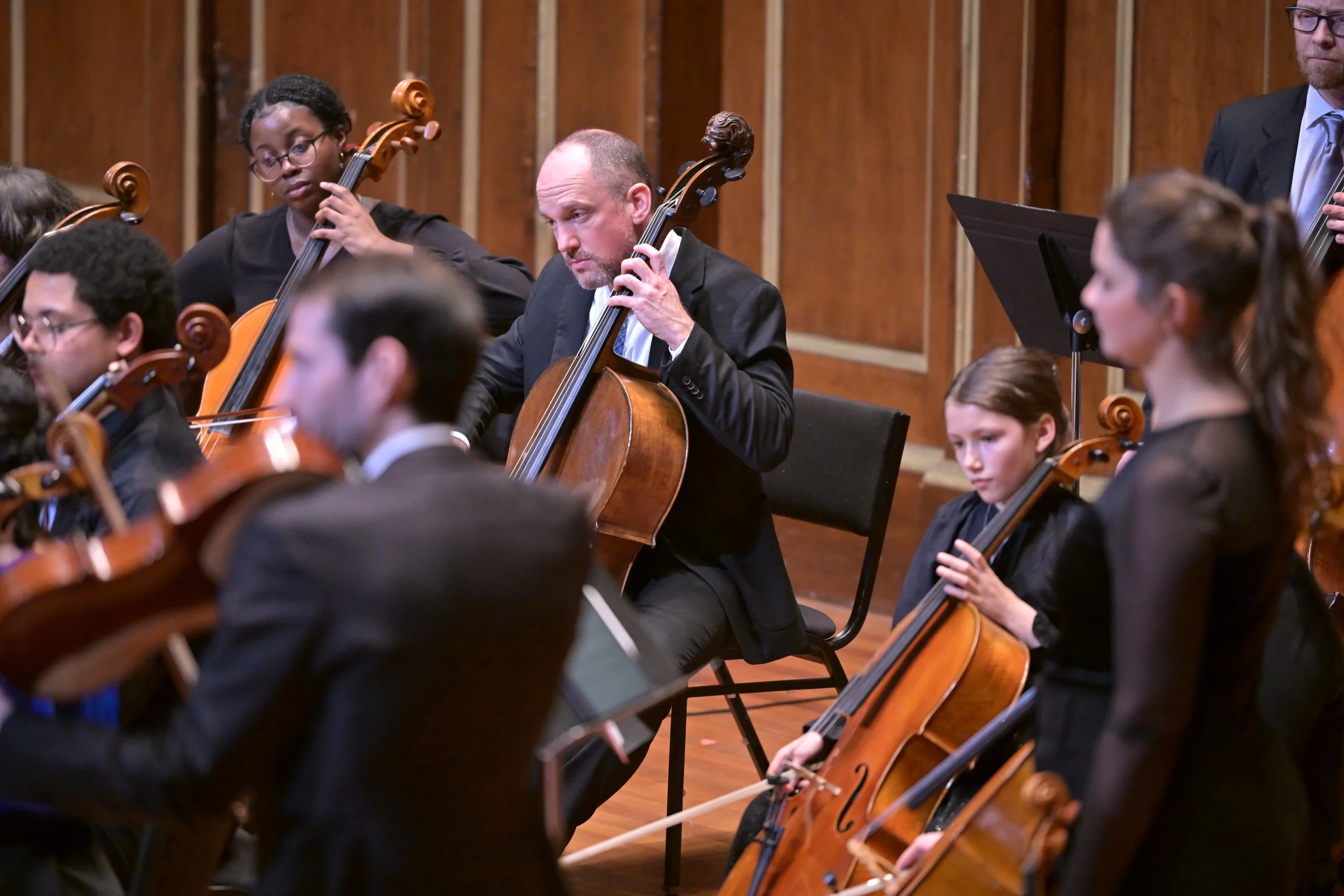
High school violinists, violists, cellists and bassists enrolled in the NEC Preparatory School! Have you ever seen A Far Cry perform in Jordan Hall, and wondered what it must be like to be a part of the group? Now's your chance.
Auditions will be held December 4, 2011 from 1pm to 6pm. Students selected will perform Shostakovich's Chamber Symphony Opus 110a, adapted form the String Quartet No. 8, in A Far Cry's concert in Jordan Hall on February 24th, 2012.
Competition flier YAC flier 11-12 Application YAC application 11-12 Excerpts: Violin DSCH 110 - Violin Viola DSCH 110 - Viola Cello DSCH 110 - Cello
* Important: When printing these excerpts be sure to select the "Document and Markups" and "Fit to Printable Area" options in the print menu.
